
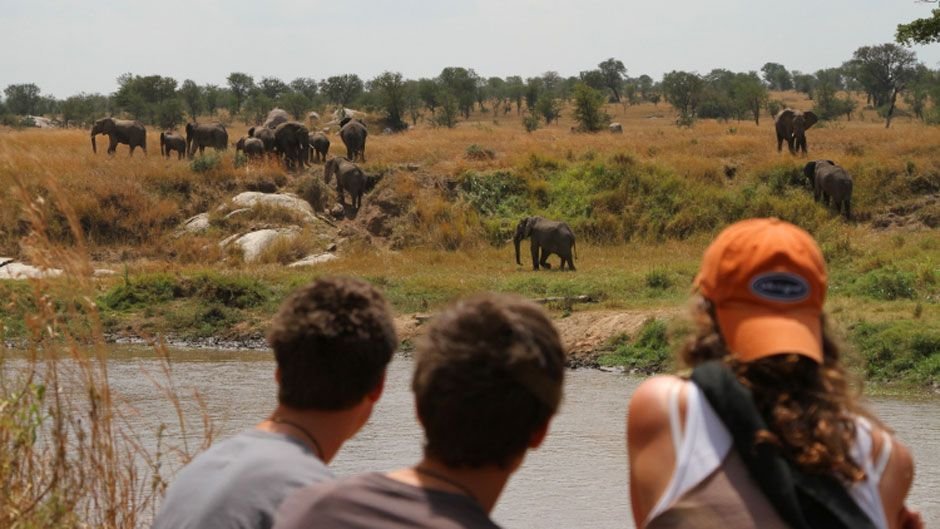
Tarangire National Park is one of the most distinctive destinations on Tanzania’s northern safari circuit. The Tarangire River, ancient baobabs and open savannah create a landscape unlike Serengeti or Ngorongoro. The park is particularly well known for elephants and for dry-season wildlife gathering around permanent water.
Tarangire covers about 2,850 km² and forms part of a much larger ecosystem connected with the Maasai Steppe. It can be visited on a day trip from Arusha, although one or two nearby nights allow a slower and more rewarding experience.
What to see in Tarangire
The scenery shifts between plains, acacia woodland, hills, baobab country, the river corridor and seasonal wetlands such as Silale. This range of habitats supports varied species and behaviour.
Elephants and large mammals
Tarangire is one of Tanzania’s best-known elephant destinations. Buffalo, giraffe, zebra, wildebeest, impala, antelope and warthog may also be seen. Lion, leopard and hyena live in the park, but sightings always depend on natural wildlife movement.
The Tarangire River
The river is a vital water source in the dry months. As water becomes scarce in surrounding areas, animals move towards the channel, pools and other permanent sources. Guides adapt the route to conditions and avoid blocking wildlife access.
Baobabs and birds
Large baobabs are a defining feature of the park and provide shelter or food for many species. Tarangire is also outstanding for birds, including ostriches, bustards, bee-eaters, raptors and wetland species. Early and late light is particularly attractive for photography.
Best time to visit Tarangire
- June to October: generally drier, with wildlife concentrating near water and easier track conditions.
- November and December: short rains may begin to transform the landscape.
- January and February: often another relatively dry period, although every year differs.
- March to May: greener and usually quieter, with birdlife and occasional muddy tracks.
The right period depends on whether you prioritise wildlife concentrations, green scenery, birds, photography, budget or fewer vehicles.
How many days do you need?
A full day introduces the northern part of the park and works well in a shorter itinerary. One or two nights inside or near Tarangire make it possible to start early, stay later and explore different sectors. Two nights particularly suit photographers, birdwatchers and travellers who prefer a relaxed pace.
Getting there and accommodation
The road journey from Arusha normally takes around two and a half to three hours, depending on traffic, the chosen gate and conditions. Accommodation inside the park maximises wildlife-viewing time; properties near the gates balance access and price; bases farther away add driving before and after the safari.
Activities and rules
Besides vehicle safaris, TANAPA may offer authorised guided walks and other activities requiring advance booking. Stay on tracks, observe speed limits, never feed or harass animals, leave the vehicle only at authorised points and never block elephants or buffalo approaching water.
Combining Tarangire
Tarangire often forms the first or final stage of a northern circuit and combines naturally with Lake Manyara, Ngorongoro and Serengeti. Compare our private 4-day safari and 2-day safari.
Frequently asked questions
Is Tarangire worth visiting?
Yes, especially for elephants, baobabs, birds and scenery distinct from the Serengeti plains.
Can Tarangire be visited in one day?
Yes. A full day provides a good safari, although staying nearby reduces transfer time.
Tarangire or Lake Manyara?
Tarangire is larger and famous for elephants and baobabs; Manyara offers a compact landscape between lake and escarpment. The best choice depends on season and itinerary.
Request a tailored proposal with dates, group size, trip length and preferred accommodation.

